I don’t know about you, but I have been searching forever for loungewear that actually feels special. You know the kind. Cozy enough for movie marathons, cute enough to answer the door without apologizing. These cow spot crochet pants are exactly that.
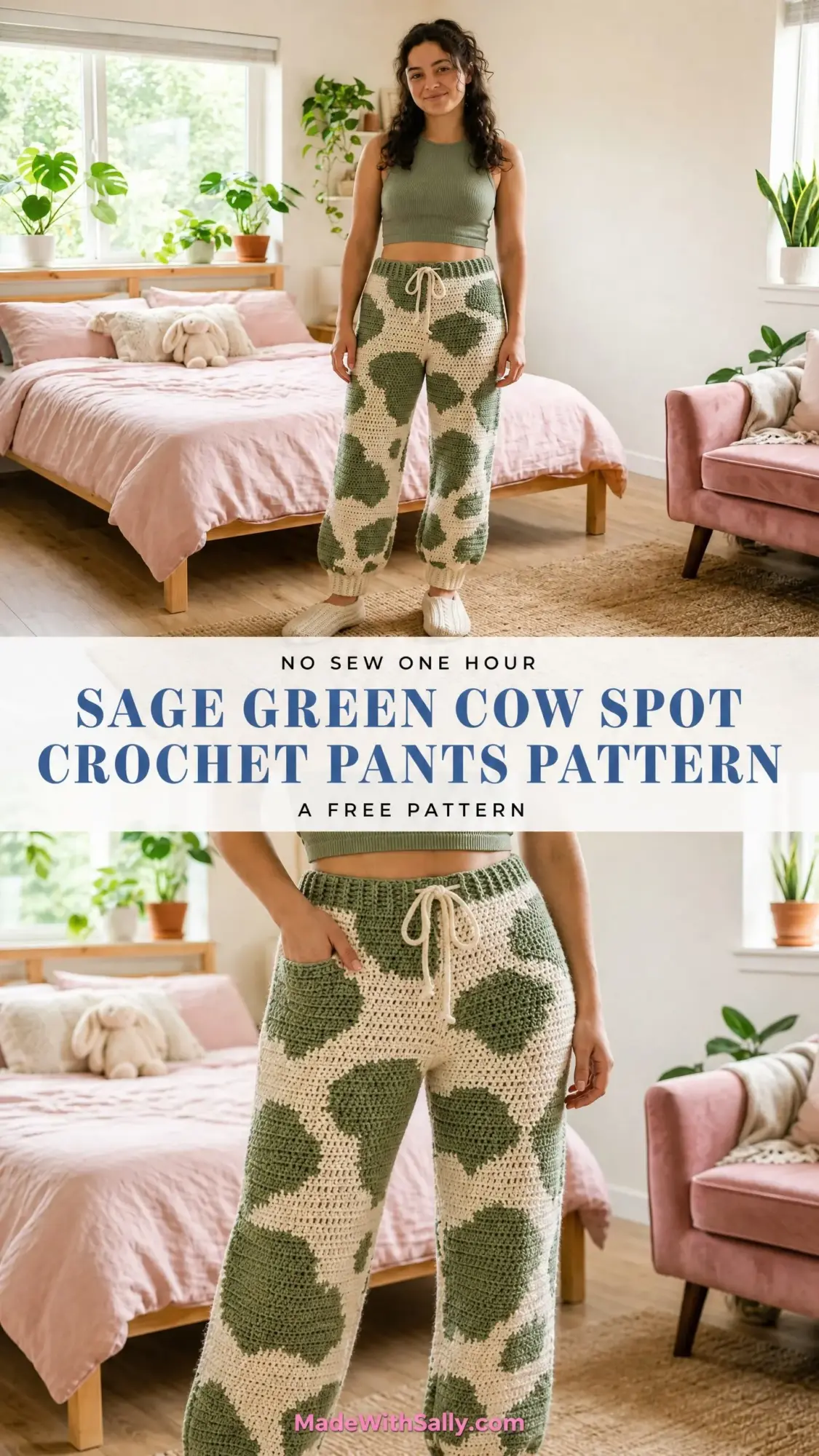
The sage green and cream colorwork gives them a modern, earthy vibe that feels fresh without trying too hard. And yes, they look impressive. But here is the secret: if you can single crochet and follow a simple chart, you can absolutely make these.
Let me walk you through everything you need to know to create your own pair of these gorgeous handmade joggers.
About This Crochet Pants Pattern
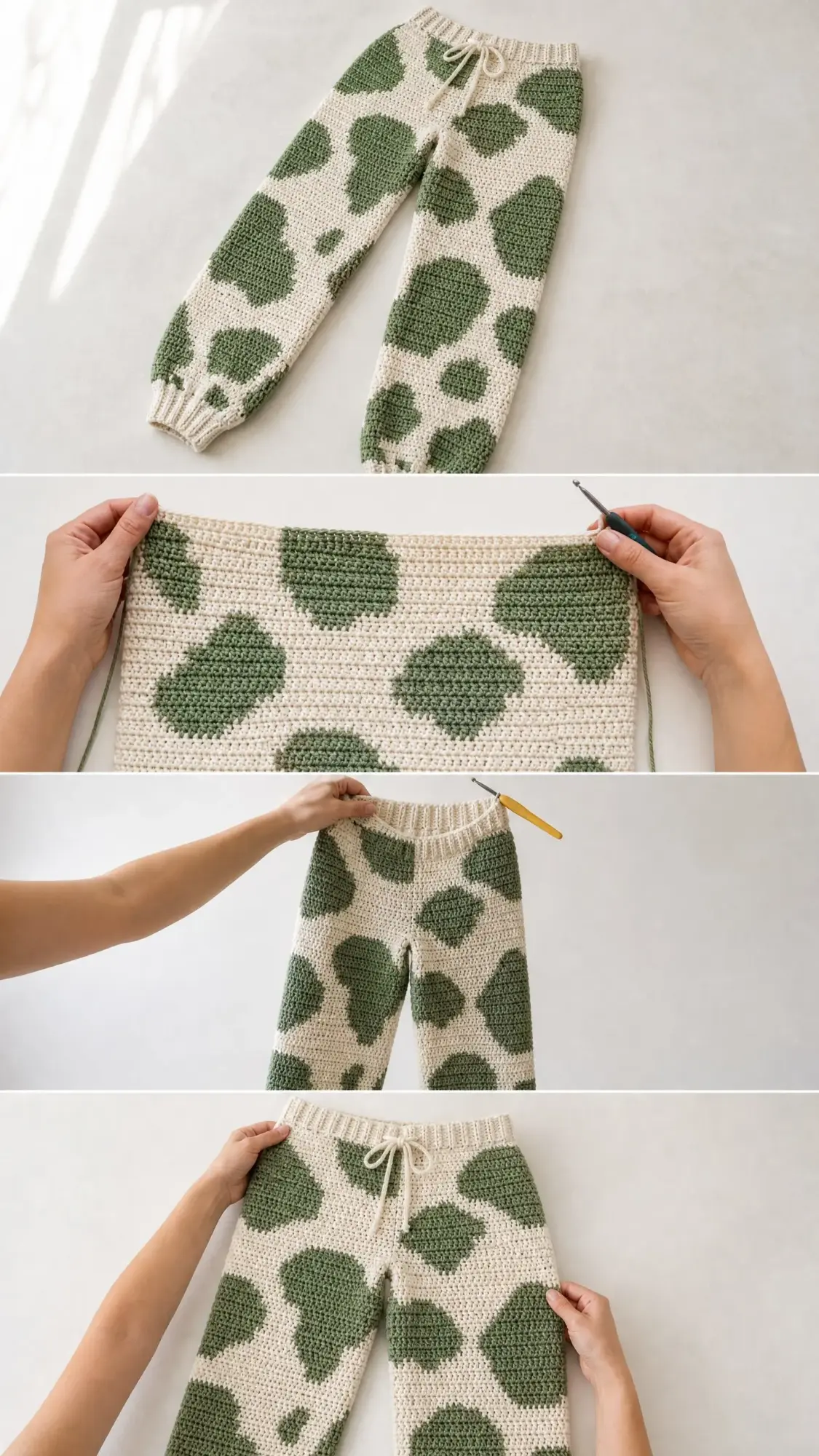
These relaxed fit crochet jogger pants feature bold cow spot colorwork in cream and sage green. The construction is straightforward once you understand the flow. You work from the waistband down to the crotch, split into two leg tubes, then continue each leg down to gathered ankle cuffs.
The cow spot motifs come to life through tapestry crochet, sometimes called intarsia in the round. This technique involves carrying the unused color behind your work while you stitch, creating a dense fabric with no messy floats on the wrong side. The result is clean, solid, and structured enough for actual wear.
These pants are perfect for lounging at home, running quick errands, or just feeling like the coolest crafter in the room.
Skill Level
This pattern is rated intermediate to advanced. Before you panic, let me break that down.
You need to be comfortable with working in the round over many stitches. You should have some experience reading a color chart. And you need patience with maintaining consistent tension throughout a larger project.
If you have made garments in the round before and tried basic colorwork, you are ready. If you are brand new to crochet, I would suggest practicing tapestry crochet on a small swatch first. Maybe make a colorwork coaster or two. Then come back when you feel confident carrying two yarns at once.
Time Estimate
Plan for 40 to 60 hours of work, depending on your speed and colorwork experience. This is a commitment project, not a weekend quickie. But every hour is worth it when you slip these on for the first time.
Finished Sizes
This pattern includes four sizes: Small, Medium, Large, and XL. Throughout the instructions, you will see numbers written as Small (Medium, Large, XL).
Waist (unstretched): 26 in / 66 cm (30 in / 76 cm, 34 in / 86 cm, 38 in / 97 cm)
Hip: 36 in / 91 cm (40 in / 102 cm, 44 in / 112 cm, 48 in / 122 cm)
Inseam length: 28 in / 71 cm (28.5 in / 72 cm, 29 in / 74 cm, 29 in / 74 cm)
Total rise (waistband top to crotch): 11 in / 28 cm (12 in / 30 cm, 12.5 in / 32 cm, 13 in / 33 cm)
Ankle circumference (unstretched over cuff): 8 in / 20 cm (9 in / 23 cm, 10 in / 25 cm, 11 in / 28 cm)
These pants are designed with 2 to 4 inches of positive ease at the hip for that relaxed jogger silhouette. Choose your size based on your actual hip measurement minus 2 inches for a closer fit, or minus 4 inches for a looser drape.
Materials Needed
Yarn A (Cream): Worsted weight, approximately 900 (1050, 1200, 1350) yards / 823 (960, 1097, 1234) meters
Yarn B (Sage Green): Worsted weight, approximately 700 (800, 950, 1100) yards / 640 (732, 869, 1006) meters
Crochet hook: US size G-6 / 4.00 mm for main fabric
Crochet hook: US size F-5 / 3.75 mm for ribbed waistband and ankle cuffs
Additional materials:
Yarn Suggestions
Lion Brand Pound of Love works beautifully here. It is 100% acrylic, machine washable, and holds tapestry colorwork tension like a dream. One skein each of Cream and Sage covers Small and Medium sizes. For Large and XL, grab two skeins of Cream and one of Sage.
Paintbox Yarns Simply DK used doubled is another great option. Their Cream White and Misty Green match this palette perfectly.
We Are Knitters The Petite Wool in Natural White and Khaki Green gives a more refined look. Just note this one requires hand washing only.
Avoid yarns with significant halo like mohair blends. The fuzz will blur your beautiful cow spots.
Gauge
Getting gauge right is critical for a garment like this. A difference of even one stitch per inch could throw off the circumference by several inches. Not fun after 50 hours of work.
With larger hook (G-6 / 4.00 mm) in tapestry single crochet worked in the round:
18 stitches x 20 rounds = 4 in x 4 in / 10 cm x 10 cm
With smaller hook (F-5 / 3.75 mm) in ribbing pattern (BLO single crochet worked flat):
20 stitches x 24 rows = 4 in x 4 in / 10 cm x 10 cm
Work a swatch of at least 5 in x 5 in / 13 cm x 13 cm. Wash it how you plan to wash the finished pants. Measure after drying. Adjust your hook size up or down as needed.
Abbreviations
Before we dive in, let me define every abbreviation you will encounter:
Special Techniques
Tapestry Single Crochet (TSC)
This is the heart of the colorwork. Here is how it works:
Insert your hook into the next stitch. Before you pull up a loop, lay the non-working yarn along the top of the row. Now pull up a loop with the working yarn, catching that carried yarn inside your stitch. Yarn over and complete the single crochet as normal.
The carried yarn gets enclosed inside each stitch body. It does not show on the right side, and you have no messy floats on the wrong side. The fabric comes out dense and clean.
Color Switching
When you need to change colors, work until the last step of the stitch before the switch. Drop the current yarn to the wrong side. Pick up the new color and use it to complete that final pull through. Never cut your yarn when switching. Carry both throughout.
Back Loop Only Ribbing
For the waistband and ankle cuffs, work all single crochets through the back loop only. This creates stretchy ridges that mimic knitted ribbing. Turn at the end of each row with a chain 1 that does not count as a stitch.
Cow Spot Color Chart
The colorwork pattern uses an 18 stitch by 20 round repeating tile. C means Cream (YA) and S means Sage Green (YB). Read every round from right to left.
Round 1: C C C S S S S C C C C S S S C C C C
Round 2: C C S S S S S S C C S S S S S C C C
Round 3: C S S S S S S S S S S S S S S S C C
Round 4: C S S S S S S S S S S S S S S S C C
Round 5: C C S S S S S S S S S S S S S C C C
Round 6: C C C S S S S S S S S S S C C C C C
Round 7: C C C C C S S S S S S C C C C C C C
Round 8: C C C C C C C S S C C C C C C C C C
Round 9: C C C C C C C C C C C C C C C C C C
Round 10: C C C S S S C C C C C C C S S S C C
Round 11: C C S S S S S C C C C C S S S S S C
Round 12: C S S S S S S S C C C S S S S S S S
Round 13: C S S S S S S S S C S S S S S S S S
Round 14: C S S S S S S S C C C S S S S S S S
Round 15: C C S S S S S C C C C C S S S S S C
Round 16: C C C S S S C C C C C C C S S S C C
Round 17: C C C C C C C C C C C C C C C C C C
Round 18: C C C C C S S S S C C C S S S S C C
Round 19: C C C S S S S S S S S S S S S S C C
Round 20: C C S S S S S S C C C S S S S S S C
The tile repeats horizontally across your full stitch count and vertically every 20 rounds. After every 20 rounds, offset the horizontal start by 9 stitches for a more organic, random spot distribution.
Step by Step Instructions
Waistband Construction
Using the smaller hook (F-5 / 3.75 mm) and Yarn A only:
Chain 17 (19, 21, 23).
Row 1: Sc in 2nd ch from hook and in each ch across. Turn. (16 sc) (18 sc, 20 sc, 22 sc)
Row 2: Ch 1 (does not count as st). Working in BLO, sc in each st across. Turn. (16 sc) (18 sc, 20 sc, 22 sc)
Repeat Row 2 until your strip measures:
This takes approximately 130 (150, 170, 190) rows.
Fasten off, leaving a 24 in / 61 cm tail. Fold the strip so short ends meet and seam them together with mattress stitch or whip stitch to form a tube.
Drawstring Eyelet Round
With smaller hook and YA, attach yarn to the top edge of your waistband tube.
Round 1: Sc evenly around, picking up approximately 1 sc per every 2 rows. Aim for 104 (120, 136, 152) sc total. Join with sl st. (104 sc) (120 sc, 136 sc, 152 sc)
Round 2 (Eyelet Round): Ch 3 (counts as sc + ch 2 for setup), sk 1 st, (sc in next st, ch 2, sk 1 st) around. End with sl st to first sc. (52 eyelets) (60, 68, 76 eyelets)
Round 3: Sc in each sc and 2 sc in each ch-2 sp around. Join. (104 sc) (120 sc, 136 sc, 152 sc)
Fasten off and weave in ends.
Body Construction
Switch to larger hook (G-6 / 4.00 mm). Working along the bottom edge of the waistband tube:
Setup Round: Attach YA. Sc around the lower edge, picking up 162 (180, 198, 216) stitches total. Join with sl st. (162 sc) (180 sc, 198 sc, 216 sc)
Place a marker at center back (your join point) and another at center front (81, 90, 99, or 108 stitches forward).
Join YB and begin carrying both yarns.
Rounds 1 to 8 (1 to 9, 1 to 10, 1 to 11): TSC in YA only around, carrying YB. Join. (162 sc per round) (180, 198, 216)
Colorwork Hip Section
Now begin the cow spot chart. Work 55 (56, 57, 58) rounds following the chart, tiling the 18 stitch repeat across all stitches. Return to chart row 1 after completing row 20. On round 41, offset your horizontal start by 9 stitches.
After all colorwork body rounds, your piece should measure approximately 11 (12, 12.5, 13) in / 28 (30, 32, 33) cm from the waistband bottom. This is your crotch split point.
Crotch Split
Work TSC across the front 81 (90, 99, 108) stitches. Chain 4 for the gusset. Skip the back stitches and slip stitch to close the first leg tube.
Adjustment Round: Work TSC around all stitches including the 4 gusset chains. Decrease 4 stitches evenly by working sc2tog at 4 spaced points. (81 sc) (90 sc, 99 sc, 108 sc)
Return to the skipped back stitches and repeat the same process to create the second leg tube.
Leg Taper and Length
Continue colorwork on each leg. After 10 plain rounds, begin decrease rounds every 3 to 4 rounds. Work sc2tog at the inner leg front and back positions, decreasing 2 stitches per decrease round.
Continue until you reach 54 (60, 66, 72) stitches and your leg measures approximately 25 in / 63.5 cm from the crotch.
Ankle Cuff
Cut YB. Work 3 transition rounds in YA only.
Switch to smaller hook. Create a ribbed strip same as the waistband: chain 11, work BLO sc rows until the strip fits around your ankle opening. Seam into a tube and attach to the leg bottom with whip stitch.
Repeat for the second leg.
Finishing
Thread your drawstring through the waistband eyelets using a safety pin or bodkin. Weave in all remaining ends. Block lightly if desired.
Care Instructions
If using acrylic yarn, machine wash cold on gentle cycle and tumble dry low. For wool blends, hand wash in cool water and lay flat to dry. The dense tapestry fabric holds up well to regular wear.
I really hope you love making these pants as much as I loved designing them. They are a labor of love, but the finished result is genuinely wearable art. Save this pattern to your Pinterest boards so you can find it when you are ready to start, and please leave a comment below if you make your own pair. I would absolutely love to see your color combinations and finished photos!